

Maximising Semiconductor Equipment Uptime: 5 Key Maintenance Tips
In semiconductor manufacturing, even brief equipment downtime can have serious consequences, from missed production deadlines to increased...
4 min read
Moving an ion implanter involves much more than picking the tool up from one location and placing it in another.
Ion implanters are among the largest, heaviest and most mechanically complex tools in semiconductor manufacturing. So the modules must be adequately protected at every stage of a move to prevent damage.
That starts with the shipping kit.
A shipping kit is a set of purpose-built fixtures and supports that secure and protect the various ion implanter sub-assemblies during moving and transportation.
In this article, we’ll cover everything you need to know about ion implanter shipping kits, including what they do, which modules they're critical for, what goes wrong without them, and how to plan for them properly.
Ion implanters are heavy, fragile and extraordinarily complex. That combination means they can't simply be wheeled out of a cleanroom and loaded onto a transport vehicle.
Their individual sub-assemblies need additional support and protection during moves to prevent damage, both within a facility and during transport.
A shipping kit serves a dual purpose. First, it stabilises sub-assemblies so they can be safely lifted and moved within the facility. Second, it helps secure the tool into a crate for safe transport to its destination.
Just like how you wouldn't ship an ion implanter whole, a shipping kit isn't just one large component either. It's a collection of multiple purpose-built parts, each designed to work with a specific sub-assembly of the implanter.
Not every module presents the same challenge. Some are simply heavy. Others are heavy and inherently unstable. Understanding the specific risks of each sub-assembly is essential to moving them safely.
Some individual modules weigh 5 or 6 tonnes or more, and several are top-heavy by design.
Without the right support, they can tip during a move, with serious consequences for the tool and the people nearby. Spreader bases and transport frames are used to lower the centre of gravity and keep unstable modules upright.
The corrector magnet module is a prime example. It's typically top-heavy and requires a spreader base to prevent tipping during both movement and transport.
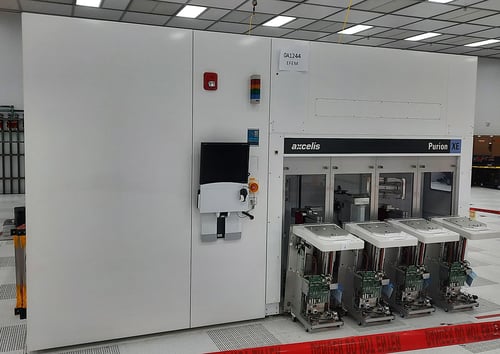
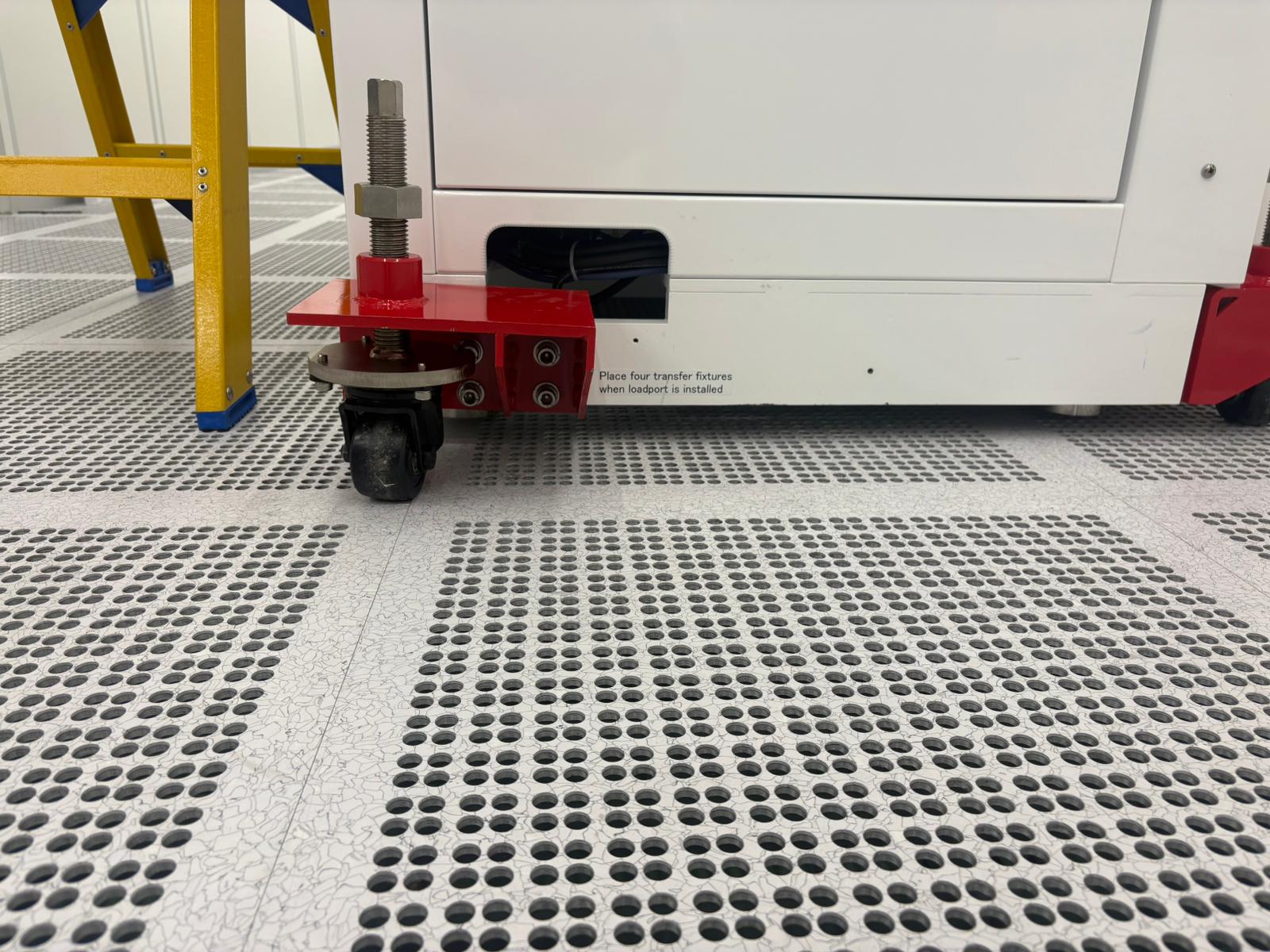
The EFEM (Equipment Front End Module), or the front-end station, presents a different but equally significant challenge. It's both narrow and tall, which makes it particularly prone to instability. The image below depicts the fixtures we’d use for a Purion M EFEM, for example.
The terminal module, while relatively well-balanced in terms of weight distribution, still demands a properly fitted shipping kit due to its sheer mass. A reasonable centre of gravity doesn't mean it can be moved without the right equipment.
See the images below for the fixtures we use for Purion M, Varian VIISION, and Varian E500 tools.
Ion implanters also contain components that are highly sensitive to movement and vibration.
Robots, for instance, need to be secured in a fixed position before any move can take place.
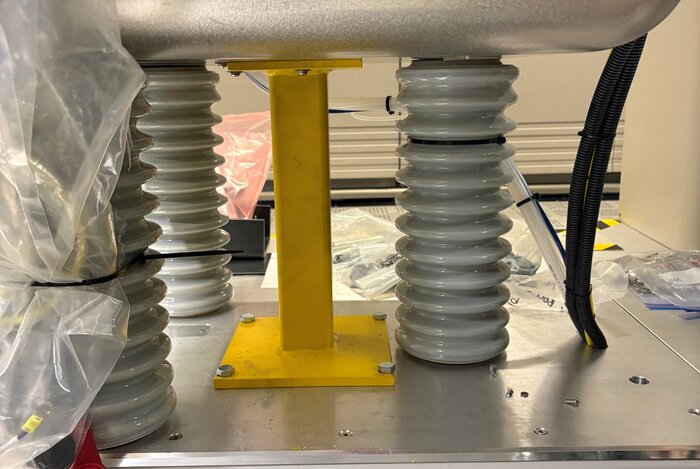
Fragile insulators, which are under high electrical stress during normal operation, must be removed entirely and replaced with dedicated transport stanchions or securing fixtures for the duration of the move.
These are not components that can simply be secured in place without the correct purpose-built supports.
Ion implanters also contain multiple vacuum tubes and beamline components that are highly vulnerable to shock. Even minor impacts can cause cracks or seal failures that require significant downtime and replacement work to resolve.
These must be carefully braced or removed before any move, as shown in the image of a Vista VHC tool below.
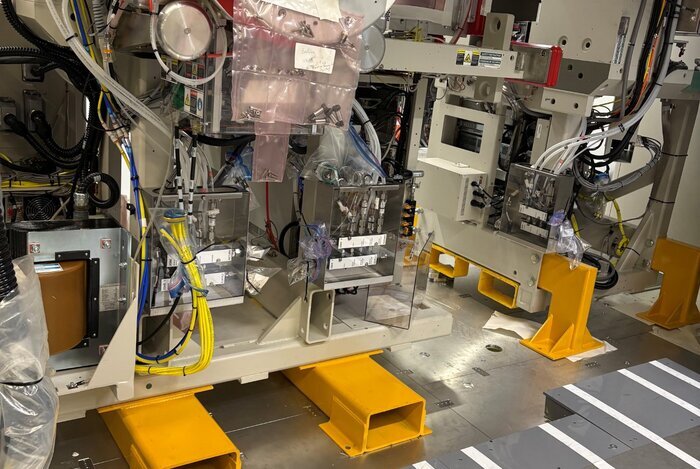
The analyser magnet must be properly secured before movement. That’s because any shifting during transport can affect its alignment with the beamline, and realigning it is incredibly time-consuming work that delays the tool's return to production.
See how we’d secure the analyser magnet on a Vista VHC tool below.
The consequences of an ill-fitting shipping kit range from inconvenient to project-stopping.
At the less severe end of the spectrum, minor dimensional differences might mean having to drill additional holes to allow bolts to be attached to a module. It's an avoidable delay, but a manageable one.
At the extreme end, if a shipping kit component simply cannot be fitted at all, everything stops. The move cannot proceed safely until the right kit is in place.
On a project with tight deadlines and production downtime already factored in, that kind of delay is one of the most disruptive outcomes a project team can face.
There are several non-negotiables when it comes to shipping kit best practices.
A shipping kit must be fitted by engineers with direct, hands-on experience with the specific implanter model and its sub-assemblies.
This isn't a task for generalists. The nuances of each module (its weight distribution, its fragile components, its securing points) require engineers who have worked on that tool before.
Shipping kit planning should begin as early as possible in the relocation project, ideally as soon as the decision to move is confirmed.
If a kit needs to be manufactured, that process typically takes 8 to 12 weeks. This is not something that can be rushed at the last minute, and leaving it too late is one of the most common and avoidable causes of project delays.
At IES, we hold drawings for most of the shipping kits required for ion implanters, which means full fabrication doesn't start from scratch.
The process involves taking existing designs through to fabrication, which involves sourcing the right materials, manufacturing the individual components, and finishing them to the required standard.
Completed shipping kit components are powder-coated in yellow. This, firstly, prevents them from corroding or oxidising. And, secondly, makes them highly visible on the shop floor and in the fab, reducing the risk of components being misplaced or overlooked during a complex, multi-stage move.
Shipping kits aren't single-use.
Once manufactured, they can be retained and reused for future moves of the same tool type, making them a sound long-term investment for fabs that regularly relocate tools, and more environmentally friendly.
Ensure a safe, efficient transition with IES ion implanter relocation services. Our specialist engineers manage the dismantle, transport, and recommissioning process to minimise downtime, protect equipment integrity, and get your tools back into production quickly and reliably.

In semiconductor manufacturing, even brief equipment downtime can have serious consequences, from missed production deadlines to increased...

Factory de-installations are never simple. But they’re a lot easier when you do them right.
Supporting implant equipment in fabs and cleanroom environments requires a unique combination of technical expertise, problem-solving skills and an...