




Low Voltage Directive Guide
The Low Voltage Directive 2014/35/EU, also known as the LVD, is a set of product safety requirements that apply to electrical equipment in the...
3 min read
If you are a manufacturer, product designer, importer, or distributor selling or supplying equipment in the European Economic Area (EEA), you need CE certification.
CE marking is the mandatory conformity mark for many types of equipment and products supplied to, or sold on, the European market complies with all applicable EU legislation, including health, safety, and environmental protection standards.
Achieving CE certification is the responsibility of the manufacturer. It is a declaration that a piece of equipment or product meets the essential requirements of the relevant European Directives or Regulations. Once affixed, the CE mark allows equipment to be sold and supplied across the EEA.
CE marking applies to a wide range of product categories, including:
Each of these categories is governed by specific EU directives or regulations which detail the standards that must be met to achieve CE certification.
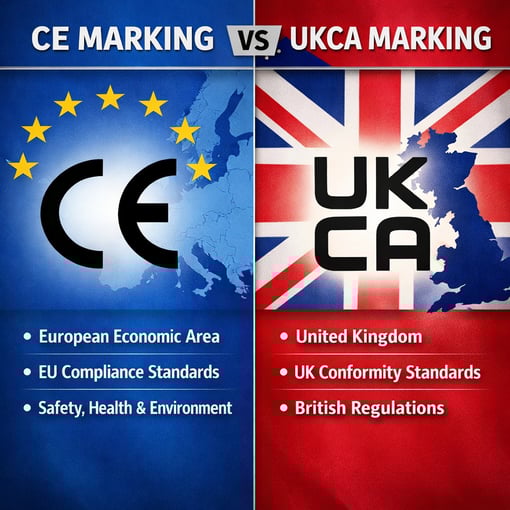
After Brexit, the UKCA mark (UK Conformity Assessed) replaced CE marking for equipment and products sold in Great Britain (England, Scotland, and Wales).
However, CE marking is still required for the EU market and accepted in Northern Ireland under specific circumstances.
CE certification is important to:
On the other hand, failing to comply with CE marking requirements can have serious consequences for manufacturers and importers, including:
CE certification is about ticking boxes, but it also helps manufacturers to build trust, ensure safety, and stay legally compliant.
CE marking is legally required for anyone placing a CE-regulated piece of equipment or product on the market within the EEA.
This includes manufacturers, who are responsible for ensuring that equipment meets EU requirements and affixing the CE mark.
CE certification is required for importers, who must verify that equipment manufactured outside the EEA complies with applicable legislation. And distributors need CE certification too - they must be sure that equipment and products bearing the CE mark are accompanied by the appropriate documentation.
An understanding of CE certification is also a necessity for many product designers and startups bringing equipment to market in Europe.
To achieve CE certification, you need to prove that your equipment meets the requirements of the specific EU directives or regulations that apply to it.
The path to CE certification involves the following:
Begin by identifying the EU directives or regulations that apply to your equipment. Each directive outlines specific safety and performance requirements. You must also determine the harmonised European standards (EN standards) relevant to your product category.
Among the most frequently applied standards for manufacturers are:
Conformity assessments involve compliance testing to ensure your equipment meets the essential requirements.
Depending on the applied directive, you may be able to self-declare compliance, or you may need to engage a Notified Body (a third-party organisation accredited by the EU).
The Technical File is a comprehensive set of documentation that demonstrates the conformity of your equipment.
It must be kept for at least 10 years and made available to authorities upon request. The Technical File typically includes; product design and specifications, risk assessments, test reports, details of manufacturing processes, instructions for the equipment and labelling.
The Declaration of Conformity (DoC) is a legally binding document via which you, as the manufacturer, declare that your equipment complies with all relevant directives. It includes
Once compliance is confirmed, you should affix the CE mark on the equipment and its packaging or accompanying documents. The mark should be easily visible and readable.
Only after this step can your equipment legally be marketed, sold and supplied within the EEA.
For many pieces of equipment, CE marking is not optional - it is a legal requirement. Beyond that, it is a signal of safety, accountability, and provides access to one of the world’s largest markets.
It is possible for manufacturers to assess the conformity of their own equipment rather than appointing a Notified Body. This is known as self declaration; this route can reduce costs and increase control of the process for manufacturers.
Compliance testing specialists such as IES allow you to achieve CE certification with the self-declaration route; guiding you through the process with expert advice and a wealth of experience. We are with you every step of the way - from identifying applicable standards to conformity assessments, and compiling your Technical File
Choose IES as your CE certification partner. Contact us today with your requirements
The Low Voltage Directive 2014/35/EU, also known as the LVD, is a set of product safety requirements that apply to electrical equipment in the...

If your business owns, operates or controls work equipment, you must comply with the Provision and Use of Work Equipment Regulations 1998 (frequently...