





The Directive becomes a Regulation, which means it will apply directly across the whole EU with no national transposition needed. See our blog: Directive Vs Regulation.
APPLIES FROM 20 JANUARY 2027
Machinery Regulation (EU) 2023/1230: What’s Changing and How to Prepare
On 20 January 2027, the new Machinery Regulation (EU) 2023/1230 will replace the Machinery Directive 2006/42/EC, with new rules covering AI, cybersecurity, and digital documentation.
If you manufacture, import, modify, or place equipment on the EU market, this new Regulation will impact your business.
Here’s everything you need to know ahead of the update, and how you can be ready for it.
FREE GUIDE: Machinery Regulation 2027: A Practical Guide for Manufacturers
Trusted By
What’s changing?
There are eight key changes coming up that you need to be ready for:
02
Safety components and self-evolving machinery using machine learning will require the strictest conformity assessment route.
03
Machinery must resist corruption, identify its own safety-critical software, and log any tampering.
04
Autonomous systems can't act beyond their defined task, and must log safety-related decisions for a year.
05
Interfaces must adapt to the operator, and equipment should communicate its planned actions.
06
Documentation can go digital by default, but must stay accessible online for at least 10 years.
07
Safety software updates must be logged and traceable for five years after the equipment is placed on the market.
08
Making a "substantial modification" now makes you the legal manufacturer, with full manufacturer obligations.
Note: Importers and distributors will also now have their own explicit obligations under the Regulation.
Do you need to act?
If your business touches equipment placed on the EU market, you will likely have obligations under the new Regulation. You might need to act if you:
- Have previously used IES or another provider for CE marking, testing or equipment compliance
- Have placed equipment on the EU market
- Develop new equipment or modify existing equipment
- Export equipment from the UK into Europe
- Are an OEM, equipment manufacturer or engineering/automation company
- Have equipment that includes connected, autonomous or software-driven functionality
Unsure? Contact our compliance experts.
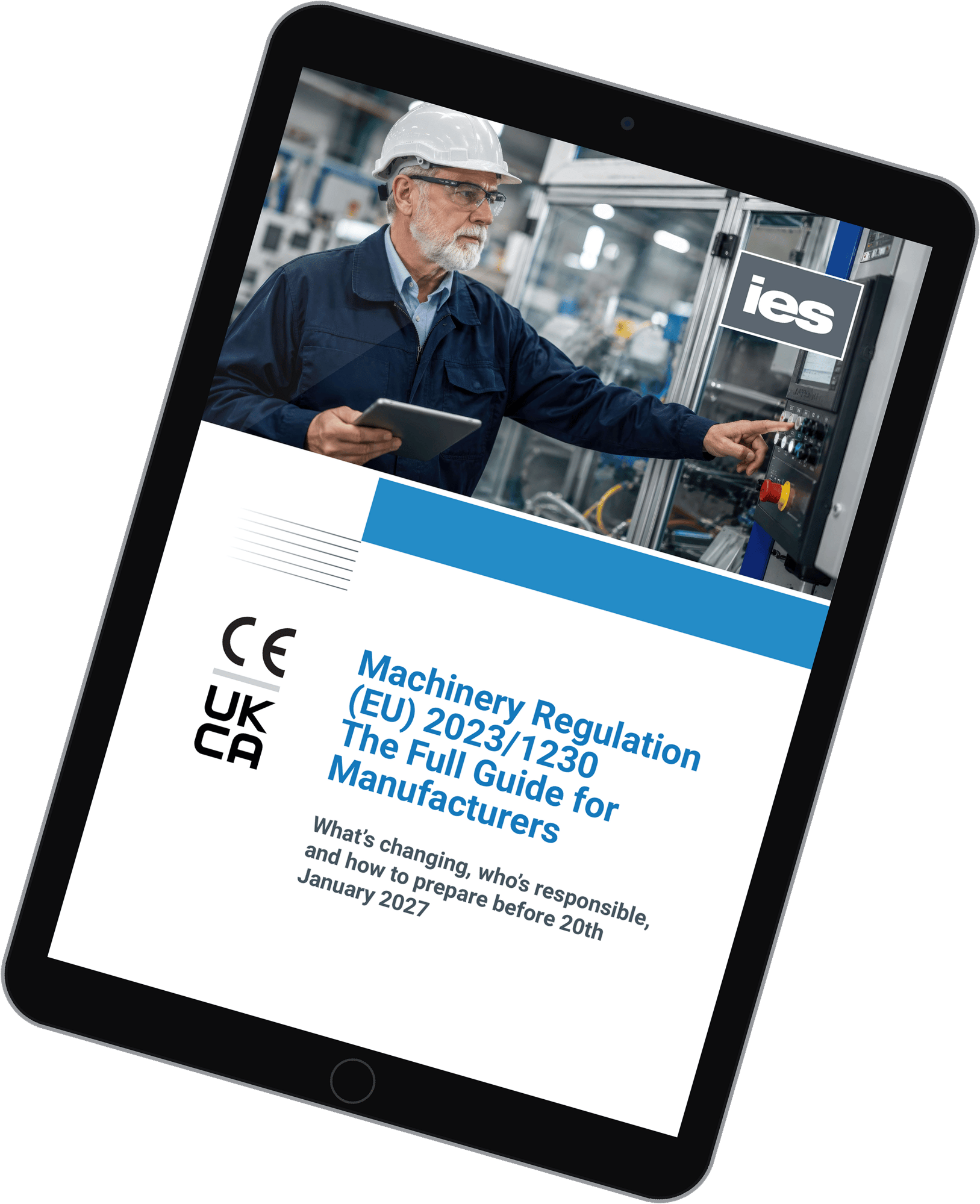
Get the free Machinery Regulation (EU) 2023/1230 guide
Get a deeper overview of what’s changing, how it will affect you, and how to prepare your business.
Enter your details
Your next steps
- 1
Identify whether your equipment falls under the new Machinery Regulation
- 2
Review your existing technical documentation against the new requirements (technical files built against the old Directive may not meet the new Regulation’s requirements)
- 3
Assess whether your machinery includes AI, self-evolving, autonomous or connected functionality that triggers the new requirements
- 4
Identify gaps in your current compliance position before January 2027
- 5
Plan your route to conformity assessment (self-certification or notified body) with plenty of time to act before the deadline
How IES can help
At IES, we have 35+ years of experience in supporting large and medium-sized capital equipment. Our start-to-finish service covers every step of the compliance testing process:
- Evaluation of equipment against relevant Machinery Regulation standards
- Comprehensive risk analysis and assessment
- Full written report of test data and any non-compliance issues
- Compilation of all technical documentation
- Consultancy and support throughout, including guidance on the most appropriate remedial actions, if required
Additional services, if required:

The service has been second to none. That’s why we call on IES again and again.
 Engineering Project ManagerCatalent Pharmaceuticals, UK
Comply with confidence
Our start-to-finish Machinery Safety Testing service covers every step of the process, from testing against the essential health and safety requirements to compiling your technical documentation and addressing remedial actions.
Request your free 20-minute consultation
Frequently asked questions (FAQs)
Will the EU Machinery Regulation 2027 apply in Great Britain or Northern Ireland?
Northern Ireland will apply the Machinery Regulation directly from 20 January 2027, under the Windsor Framework.
Great Britain remains governed by the UK’s Supply of Machinery (Safety) Regulations 2008. So the Regulation will not impact equipment using the UKCA mark. However, GB continues to recognise the CE mark. So, the Regulation will apply to any equipment certified under the CE mark in GB.
When does the Machinery Regulation come into force?
The Regulation was adopted by the European Parliament and the Council on the 14th of June 2023, but it doesn't become mandatory until 20 January 2027.
What's the difference between a Directive and a Regulation?
A Directive has to be transposed into each country's national law, which can create small differences between Member States. A Regulation applies directly and identically across the whole EU, with no national transposition step required.
What equipment does the Machinery Regulation apply to?
The new Machinery Regulation covers machinery itself, related products (interchangeable equipment, safety components, lifting accessories, chains, ropes and webbing, and removable mechanical transmission devices), and partly completed machinery.
Some equipment is excluded, including fairground equipment, machinery for nuclear installations, weapons, most vehicles already covered by their own EU type-approval rules, and household electrical or electronic products already covered by the Low Voltage or Radio Equipment Directives.
Do I need a notified body to certify my equipment?
It depends on the risk category your equipment falls into. Higher-risk categories (including safety components and equipment with self-evolving behaviour) require mandatory third-party involvement from a notified body.
Lower-risk categories can self-certify, but only if the equipment is built entirely in accordance with the relevant standards.
Will my current CE marking documentation still be valid?
Not necessarily. Technical files built against the old Directive may not meet the new Regulation's requirements, particularly around cybersecurity, AI/self-evolving behaviour, and the new digital documentation rules. It's worth reviewing your existing documentation ahead of the deadline rather than assuming it carries over.
What counts as a "substantial modification"?
A physical or digital change that creates a new hazard or increases an existing risk, in a way that requires extra guards, protective devices, or additional stability or strength measures.
If you make this kind of change to existing equipment, you're treated as the legal manufacturer for it, with the full set of manufacturer obligations attached.
Who is responsible for compliance?
Manufacturers (including those building equipment for their own internal use), authorised representatives, importers, and distributors. Anyone carrying out a substantial modification is also treated as a manufacturer, except for a non-professional user modifying their own equipment for their own use.
Does the Machinery Regulation replace CE marking altogether?
No. The Machinery Regulation is one of several pieces of EU legislation covered by the CE marking framework. Equipment often needs to meet more than one (for example, the Low Voltage Directive or EMC Directive alongside the Machinery Regulation). The CE mark represents compliance with all applicable EU legislation, not just one.